|
Office) LG 409 |
1.jpg) |
|
Phone) +82-54-279-2377 |
|
|
E-mail) jcho (at) postech (dot) ac (dot) kr |
|
|
Office Hours: 15 minutes before and after the in-class meeting; by appointments |
Announcements Syllabus Schedule/Downloads
Syllabus for Fall 2023 (Last update: 09/05/23)
EECE 233 Signals and Systems (3-0-3)
EECE 233 신호 및 시스템 (3-0-3)
In-class meetings at LG 102 on every TTh 11:00-12:15. For exceptions, see Schedule/Downloads.
Instructor: Professor Joon Ho Cho
Office) LG 409
Phone) +82-54-279-2377
E-mail) jcho (at) postech (dot) ac (dot) kr
Office Hours: 15 minutes before and after the in-class meeting; by appointments
TA: 함범주
E-mail> bjham (at) postech (dot) ac (dot) kr
Office Hours: TBA
Tutor: 신동환
E-mail> sdh0609 (at) postech (dot) ac (dot) kr
Office Hours: TBA
Homepage: http://cisl.postech.ac.kr/class/eece233/
Announcements, HW, Quiz, Exams will be updated on PLMS: https://plms.postech.ac.kr/course/view.php?id=8640
You can download lecture resources from the homepage: http://cisl.postech.ac.kr/class/eece233/schedule.htm
YouTube Channel: Search for "cisl.postech" at YouTube.
|
|
|
|
|
|
|
|
While I will make every effort to upload videos of all class meetings, please note that it is not my responsibility to ensure that all videos are available. Thank you for your understanding.
Weight 1. Quiz #1 (TBA, MM/DD, Lec. #1-#XX at LG 102)
10 %/Fail
2. midterm exam (TBA, MM/DD, Lec. #1-#XX at LG 102)
20 %/Fail
3. Quiz #2 (TBA, MM/DD, Lec. #1-#XX at LG 102)
10 %/Fail
4. Final exam (TBA, MM/DD, Lec. #1-#29 at LG 102)
40 %/Fail
5. Homework
20 %/Fail
6. Class attendance ( >=3/4 of total) Pass/Fail 7. Voluntary Project 1 grade up or not
100 %
Quiz and Exam: Open everything except no interactive assistance Homework: No collaboration allowed.
- Attendance
- There will be no penalty at all until 1/4 unexcused absences of approx. 30 class meetings including those within the registration period.
- But more than 1/4 unexcused absences will result in F without exception.
- For excused absences, please provide the related documents and confirm that the electronic attendance system shows your attendance.
- Remember that the system regards 2 late attendances as a single absence.
- Grading Policies for Homework and Quiz
- Re-grade requests must be filed in writing within one week after graded quizzes have been returned to students.
- Grading Policies for Exam
- Re-grade requests must be filed in writing within one week after the graded exam has been returned to students.
- Final Grade
- How to obtain the final weighted sum: https://youtu.be/XcCtY-25ybg?t=8
- If you achieve >1.5 sigma in the weighted sum: https://youtu.be/XcCtY-25ybg?t=52
- How to determine the final grade: https://youtu.be/XcCtY-25ybg?t=148
- Voluntary Project: 15-20 min. presentation on your report, MATLAB code, etc.
- If you are about to fail in this course: https://youtu.be/XcCtY-25ybg?t=189
- This is not applicable if your unexcused absences > 1/4 of class meetings.
- What I expect from you in this course:
- How to study in POSTECH: https://youtu.be/ol9eLr2XAQI
- Greek Letters: https://youtu.be/0mt0FOEzTzE
- Policy on Academic Dishonesty
- If the instructor suspects academic dishonesty, the instructor will notify the student(s) and follow the procedure to report to the school without any exception.
- Students have the responsibility to be knowledgeable about the consequences of dishonesty.
- See, recently published report cover page and academic honesty guide.
Textbook: You are strongly advised to buy/obtain the textbook.
A. V. Oppenheim and A. S. Willsky, Signals and Systems, 2nd Edition. Prentice Hall, 1996
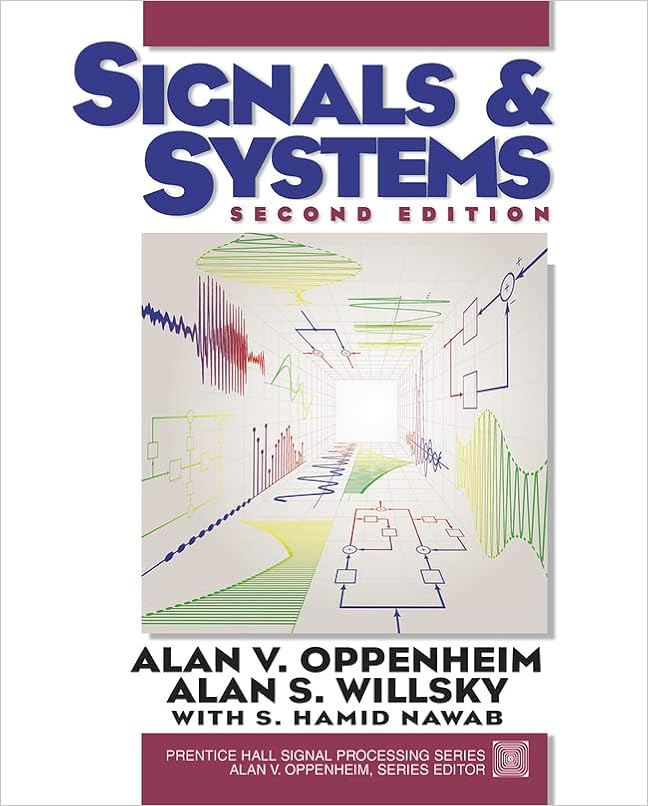 Why
have I adopted this book as a text?
https://youtu.be/-AUDj-PqILs
Why
have I adopted this book as a text?
https://youtu.be/-AUDj-PqILs
References: These references are available at the POSTECH library.
H. Hsu, Schaum's Outline of Signals and Systems, McGraw-Hill, 1995 (The book is available as an e-Book at the POSTECH library.)
Haykin, Van Veen, Signals and Systems, 2nd Edition
Pre-requisites:
(For any pre-requisite related questions, consult the instructor.)
Calculus, Linear Algebra, Differential Equations (or working knowledge on linear constant-coefficient differential equations)
Course Objectives:
This course lays the groundwork for further studies in Communications, Signal Processing, Control, and related fields. By completing this course, students will gain an understanding of:
1. the concepts of signals and systems,
2. how to analyze linear time-invariant systems by using time-domain and frequency-domain approaches,
3. how to design linear time-invariant systems by using time-domain and frequency-domain approaches,
4. how to convert a continuous-time signal to a discrete-time signal, and vice versa.
Order of the coverage (The numbers are the chapter numbers of the textbook)
1. Signals and Systems
2. Linear Time-Invariant Systems
3. Fourier Series Representation of Periodic Signals
4. Continuous-time Fourier Transform
5. Discrete-time Fourier Transform
6. Time and Frequency Characterization of Signals and Systems
9. Laplace Transform
10. Z-transform
7. Sampling
8. Communication Systems